

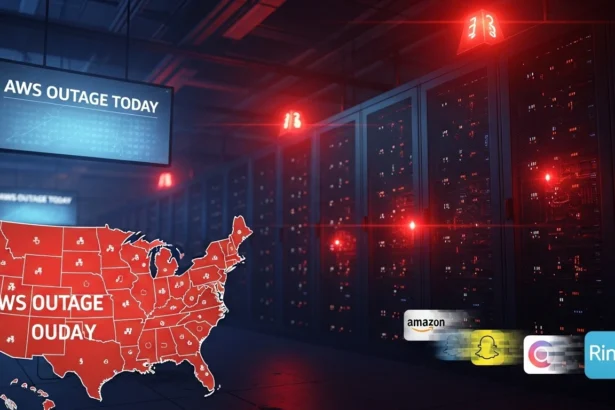
A massive AWS outage today has caused widespread disruption across the United States, taking down major platforms including Amazon, Snapchat, Ring, and several other popular services. The outage, which began early Monday morning, left millions of users unable to access websites, smart devices, and online tools—highlighting once again how deeply our digital world depends on Amazon Web Services.
What Happened During the AWS Outage Today
The outage started around 3:00 AM ET, when users began reporting issues logging into Amazon.com, sending messages on Snapchat, and connecting to Ring smart cameras. Within minutes, thousands of reports flooded Downdetector, marking one of the largest AWS disruptions of 2025.
According to Amazon’s official AWS status dashboard, the incident originated in the US-EAST-1 region—the company’s largest cloud hub, based in Northern Virginia. Amazon confirmed that multiple AWS services were experiencing “increased error rates and latency.”
By mid-morning, the outage spread to several other U.S. regions, affecting businesses, developers, and everyday users alike.
Which Services Were Impacted
The AWS outage today didn’t just hit Amazon-owned platforms. Because AWS powers thousands of apps and websites, the ripple effect was massive:
- Amazon.com & Prime Video—Customers faced login errors and slow loading pages.
- Snapchat—Users couldn’t send snaps or refresh their feeds.
- Ring & Alexa—Smart devices failed to connect to the internet.
- Venmo & Robinhood—Financial app transactions lagged or stalled.
- Canvas & Zoom—Students and professionals struggled to access online tools.
- Gaming Apps—Roblox and Fortnite servers faced connectivity drops.
Social media quickly filled with frustrated posts and memes, as users across the U.S. trended hashtags like #AWSOutage and #InternetDown.
AWS Responds: “We’re Working to Restore Services”
In a brief statement, Amazon Web Services acknowledged the disruption, saying their team was “actively investigating network connectivity issues in the US-EAST-1 region.”
“We’re working to fully restore all impacted services as quickly as possible,” AWS said in its latest update.
By late morning, partial recovery began, with some services returning online. However, several users reported lingering issues, especially with Alexa voice commands and third-party apps hosted on AWS servers.
Was It a Cyberattack?
As “cyber attack today” trended on social media, Amazon clarified there was no indication of a security breach or attack. Experts believe the AWS outage today was caused by internal infrastructure issues — possibly involving load balancers or a Domain Name System (DNS) failure.
Tech analysts note that such problems are not uncommon for large-scale cloud providers. Still, they highlight the growing risk of centralization, where a single point of failure can take down huge portions of the internet.
Why This AWS Outage Matters
AWS hosts more than 30% of global cloud infrastructure, powering everything from e-commerce to education. When AWS goes down, entire industries feel the impact — from payments and smart homes to entertainment and logistics.
For users, it’s an inconvenience. For businesses, it’s a costly reminder of how fragile digital infrastructure can be.
This latest AWS outage also reignites debates over the “too big to fail” nature of cloud giants, pushing companies to consider multi-cloud backup systems and more resilient architectures.
Stock Market Reaction
Shares of Amazon (AMZN) dipped slightly in pre-market trading following reports of the outage. Analysts predict the short-term impact on revenue will be minimal, but repeated incidents could raise concerns among enterprise clients who depend on AWS reliability.
When Will AWS Be Back to Normal?
As of the latest update from AWS’ Service Health Dashboard, Amazon engineers have restored most critical services, though some users may still experience slow responses or login issues.
AWS says it will release a full post-incident report detailing the root cause and preventive measures in the coming days.