

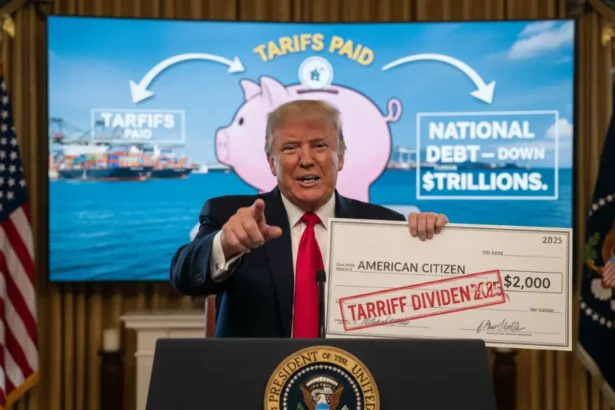
In a bold move amid ongoing debates over trade policies, President Donald Trump has reignited discussions about the 2000 tariff dividend with a fresh promise of direct financial relief for everyday Americans. On November 9, 2025, Trump took to Truth Social to declare that his administration’s tariffs—imposed on imports from major trading partners like China, Canada, Mexico, and the European Union—would fund a $2000 stimulus payment for most citizens. “A dividend of at least $2000 a person (not including high income people!) will be paid to everyone,” he wrote, framing it as a reward for the economic resurgence sparked by these measures. This isn’t the first time Trump has floated the idea of a Trump $2000 check or Trump $2000 dividend, but the timing feels urgent. It comes just days after the U.S. Supreme Court heard arguments challenging the legality of his broad tariff strategy under the International Emergency Economic Powers Act (IEEPA), leaving the fate of billions in revenue hanging in the balance.
As families grapple with rising costs and a national debt pushing $37 trillion, the prospect of a 2000 payment has sparked hope—and skepticism. Could this be the next chapter in stimulus-style relief, similar to the pandemic-era checks? In this article, we’ll break down the proposal’s origins, eligibility criteria, mechanics, potential impacts, and hurdles ahead. Whether you’re wondering if you’ll qualify for this 2000 stimulus payment or how it fits into Trump’s broader economic vision, here’s everything you need to know.
Also Read: Snap November 2025 Update: Key Features and What’s New
What Is the 2000 Tariff Dividend?
At its core, the 2000 tariff dividend is a proposed rebate program designed to redistribute revenue generated from U.S. import tariffs back to American households. Trump has long championed tariffs as a tool to protect domestic industries, reduce trade deficits, and bring manufacturing jobs home. Since his “Liberation Day” announcement in April 2025, which expanded duties to nearly every foreign nation, tariff collections have surged. The U.S. Treasury reported $215.2 billion in fiscal year 2025 alone—up 150% from the previous year—thanks to rates as high as 60% on Chinese goods and 25% on steel and aluminum from elsewhere.
Trump envisions these funds not just as a buffer against foreign competition, but as a direct “dividend” for taxpayers. In an October 2025 interview with One America News Network, he first hinted at payouts ranging from $1,000 to $2,000 per person, projecting annual revenues exceeding $1 trillion. The latest iteration ties into his administration’s dual goals: easing affordability pressures while chipping away at the national debt. Excess funds after distributions, Trump clarified on November 10, would “SUBSTANTIALLY PAY DOWN NATIONAL DEBT.” It’s a populist pitch—turning trade policy into pocket money—but experts warn it could mask deeper economic trade-offs, like higher consumer prices from passed-on import costs.
This proposal echoes earlier efforts, like Senator Josh Hawley’s American Worker Rebate Act of 2025, which aimed for $600 per adult and dependent child (up to $2,400 for a family of four). That bill stalled in committee, but Trump’s endorsement could revive similar legislation.
Who Qualifies for the 2000 Tariff Dividend?
Eligibility details remain fuzzy, as the White House hasn’t released a formal plan. Based on Trump’s statements and administration hints, the Trump $2000 dividend targets “low- and middle-income” Americans, explicitly excluding “high income people.” Here’s a breakdown of what we know so far:
| Category | Likely Eligible? | Details |
|---|---|---|
| Income Threshold | Yes, if under ~$100,000 (individual) or ~$200,000 (household) | Trump hasn’t specified, but analysts peg “high income” at the top 20% of earners (per Pew Research). This could cover ~80% of U.S. households, or about 270 million people. Past stimulus checks used $75,000/$150,000 cutoffs, so expect something similar. |
| Adults | Yes | All qualifying U.S. citizens or legal residents over 18, potentially including retirees and gig workers. |
| Children/Dependents | Possibly | Unclear if kids get separate checks; Hawley’s bill included them, but Trump’s phrasing focuses on “a person.” If included, it could add $100 billion+ to costs. |
| High-Income Earners | No | Excluded to prioritize working-class relief; exact cutoff TBD by Congress. |
| Non-Citizens | No | Limited to U.S. taxpayers, mirroring COVID-era rules. |
| Special Groups (e.g., SSDI Recipients) | Likely Yes | Broad “everyone” language suggests inclusion, but verification via IRS/Social Security data would apply. |
To qualify, you’d likely need to file a 2025 tax return, with the IRS handling distribution based on adjusted gross income (AGI). A White House official emphasized the administration’s “commitment to putting this money to good use for the American people,” but no application process has been outlined yet. Social media buzz, including X posts from users like @amitisinvesting, reflects excitement but also questions: “Are we doing stimmy checks again?” Bottom line: If your household income aligns with middle-class norms, you’re probably in line—but Congress will define the fine print.
How Would the 2000 Tariff Dividend Work?
The mechanics of delivering a 2000 payment hinge on congressional approval, as tariffs alone can’t authorize direct payouts under current law. Here’s a step-by-step look at how it could unfold:
- Funding Source: Tariffs collected by U.S. Customs and Border Protection flow to the Treasury. With $300–$400 billion projected annually (and $3.3 trillion over a decade per CBO estimates), there’s enough to cover ~150 million adult recipients at $2,000 each—totaling $300 billion yearly. Importers pay upfront, but costs often trickle down to consumers via higher prices.
- Legislative Path: Trump would need a bill like an updated American Worker Rebate Act. Once passed, funds allocate via the IRS, similar to 2020–2021 stimulus rounds. Treasury Secretary Scott Bessent noted it “could come in lots of forms,” such as tax credits, no-tax-on-tips/overtime deductions, or direct deposits—potentially debuting in 2026 tax filings.
- Distribution Timeline: No firm date exists, but Trump implied “soon” after debt priorities. If approved by early 2026, payments could hit accounts by summer—via direct deposit, paper check, or prepaid debit card. Verification would use 2024 tax data, with opt-outs for overpayments.
- Surplus Allocation: Post-payouts, leftovers tackle the $37 trillion debt. Trump posted on November 10: “All money left over… will be used to SUBSTANTIALLY PAY DOWN NATIONAL DEBT.” At current revenues, this could shave billions annually.
Bessent downplayed a literal check, suggesting it might manifest as broader tax relief, like exempting Social Security benefits—equating to ~$2,000 in savings for many. On X, reactions range from pragmatic (“Earn $20 in bitcoin after first $25”) to skeptical (“Ain gonna be no dividend”).
Potential Benefits and Challenges
Pros:
- Immediate Relief: A Trump $2000 check could boost spending in struggling sectors, from groceries to housing, amid 3% inflation.
- Economic Rebalancing: Encourages domestic production, potentially creating 1–2 million jobs in manufacturing.
- Debt Dent: Surplus application aligns with fiscal hawks’ priorities.
Cons:
- Inflation Risk: Tariffs have already hiked prices by 1–2% on imports; adding cash could fuel demand-pull inflation.
- Legal Clouds: SCOTUS skepticism could invalidate IEEPA-based tariffs, triggering refunds to importers and slashing revenue. A ruling is expected by June 2026.
- Math Mismatch: Net revenue after offsets (e.g., lost payroll taxes) might only yield $90 billion annually—far short of $300 billion needed. Critics like Maya York of the Committee for a Responsible Federal Budget call it a “trap” for retirees.
Public sentiment on X mirrors this divide: Enthusiasm from patriots (“God loving Patriot who FOLLOWS BACK ALL PATRIOTS”) clashes with cynicism (“$2000 – how embarrassing”).
What’s Next for the 2000 Tariff Dividend?
Trump’s announcement feels like a strategic play: Rallying support for tariffs while preempting SCOTUS backlash by positioning the court as the “bad guy” blocking relief. As one X user noted, it recasts tariffs as a “win” for Americans, not just a tax. But realization depends on a divided Congress, where Republicans prioritize debt reduction and Democrats decry regressive impacts.
If passed, this 2000 stimulus payment could redefine trade policy as citizen dividends, blending protectionism with populism. For now, it’s a tantalizing “what if”—one that could land in your bank account or evaporate in court. Stay tuned: With midterms looming, pressure for action will mount. Have questions about your eligibility? Check IRS guidelines as they evolve, and weigh in below: Would you spend your Trump $2000 dividend on debt payoff or daily needs?
This article is for informational purposes only and not financial advice. Tax implications vary; consult a professional.