

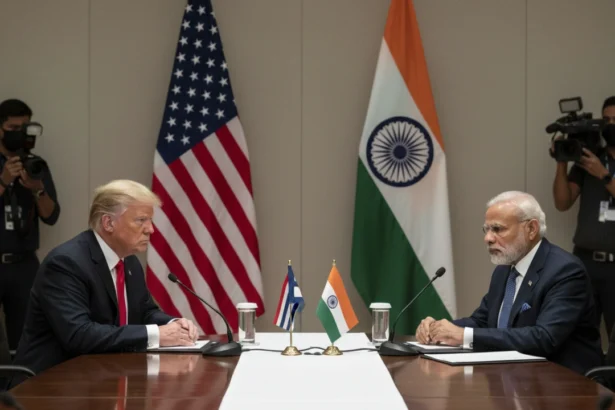
New Delhi/Washington: Former U.S. President Donald Trump has once again stirred the global diplomatic waters—this time claiming that Indian Prime Minister Narendra Modi has agreed to stop importing oil from Russia, a move that could mark a seismic shift in global energy and trade dynamics.
But while Trump made the announcement with confidence, India has stayed silent, choosing its words carefully as the world watches how this could reshape its energy security strategy.
What Trump Said
Speaking during a press briefing in Washington on Wednesday, Trump asserted that Modi had personally assured him that India would “end its oil purchases from Russia” in the near future.
“He (Modi) has assured me there will be no oil purchased from Russia. You know, you can’t do it immediately—it’s a little bit of a process—but the process is going to be over with soon.”
— Donald Trump, quoted by the Associated Press.
Trump positioned this as part of his broader effort to pressure Moscow over the ongoing Ukraine war, suggesting that if major nations like India cut off Russian energy revenues, it would accelerate a peace deal.
He also hinted that the U.S. could offer energy cooperation and trade incentives to India in exchange for cutting ties with Russian oil suppliers.
🇮🇳 India’s Response: Strategic Silence
In sharp contrast, New Delhi has not confirmed Trump’s claims. The Ministry of External Affairs (MEA) avoided a direct answer, emphasizing instead that India’s energy decisions are guided by national interests, not foreign influence.
MEA spokesperson Randhir Jaiswal said during a routine press briefing:
“Ensuring stable energy prices and secured supplies have been the twin goals of our energy policy. This includes broad-basing our energy sourcing and diversifying as appropriate to meet market conditions.”
No mention was made of any commitment to halt Russian oil imports—a silence that many analysts say speaks volumes.
India’s cautious response reflects a familiar diplomatic pattern—asserting strategic autonomy while avoiding open confrontation with major powers like the U.S. or Russia.
The Numbers: India’s Energy Reality
India, the world’s third-largest oil consumer, heavily depends on imported crude to fuel its economy. Over the past two years, Russia has become one of India’s top oil suppliers, offering steep discounts amid Western sanctions.
According to Reuters, Russian oil accounted for roughly 36% of India’s total crude imports in mid-2025, slightly down from 40% in 2024—but still significant.
While some Indian refiners have reportedly begun reducing Russian oil purchases under quiet U.S. pressure, others—like Mangalore Refinery and Petrochemicals Ltd (MRPL)—have signaled a desire to keep buying discounted crude as long as it remains economically viable.
Energy experts note that cutting Russian oil completely would require major structural adjustments in India’s refining and sourcing strategy—and could lead to higher domestic fuel prices.
Why India Is Cautious
India’s silence is not just political—it’s strategic. Several key factors are at play:
- Energy Security Comes First
India cannot afford supply disruptions or price spikes that could hit its inflation-sensitive economy. - Strategic Autonomy
New Delhi has consistently rejected being drawn into bloc politics, maintaining independent relations with the U.S., Russia, and the EU alike. - Defense and Diplomatic Balance
Russia remains a crucial defense and technology partner. Cutting oil ties could strain those long-standing relationships. - Economic Pragmatism
Discounted Russian oil has helped India manage costs and maintain growth in a turbulent global economy. - Political Optics
Domestically, the Modi government is keen to project strength and sovereignty, not subservience to foreign leaders—especially amid upcoming state elections.
The Global Stakes
If India were to actually commit to ending Russian oil imports, it could reshape global energy markets and increase Western leverage over Moscow.
However, analysts caution that Trump’s statement may be premature or exaggerated, potentially part of his political posturing ahead of the 2026 U.S. elections.
For Russia, losing India as a buyer would be a blow. For the U.S., it would mark a diplomatic win—showcasing Trump’s ability to influence major economies without direct sanctions.
For India, however, the move could risk inflationary pressure at home and test its “neutral” stance in global
What Comes Next
So far, there are no official signs that India has halted its Russian oil contracts. Experts expect New Delhi to gradually diversify rather than abruptly cut ties—shifting toward Middle Eastern, U.S., and African crude over time.
Meanwhile, the U.S. has hinted at new trade incentives if India aligns more closely with Western sanctions, suggesting a mix of diplomacy and pressure is underway behind closed doors.
Bottom Line
Trump’s bold claim that Modi agreed to end Russian oil imports has thrown India’s energy diplomacy into the spotlight.
But New Delhi’s silence signals a familiar message—India will continue to pursue an independent path, balancing its global partnerships while safeguarding its national interests.
Until there’s an official statement from India, the claim remains just that—a claim.