

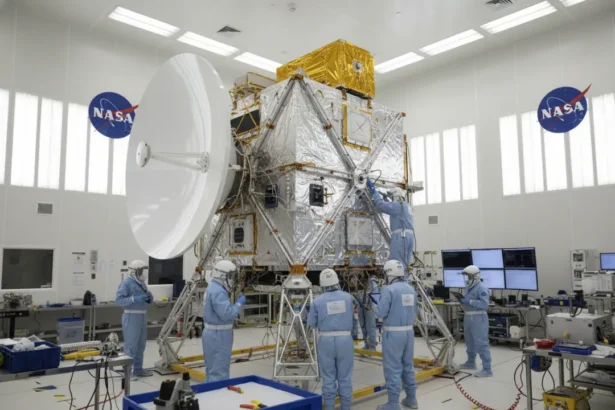
October 14, 2024 — Cape Canaveral, Florida: NASA has officially launched its $5 billion Europa Clipper mission, marking one of the most ambitious attempts in history to explore the potential for life beyond Earth. The spacecraft took off from Cape Canaveral on October 14, 2024, aboard a SpaceX Falcon Heavy rocket, starting a journey that will take nearly six years to reach its destination — Jupiter’s icy moon, Europa.
A Mission with a Bold Purpose
The Europa Clipper mission is designed to answer one of humanity’s oldest questions — are we alone in the universe?
While it won’t directly search for living organisms, the spacecraft will study whether Europa has the right conditions to support life. Scientists believe that beneath the moon’s icy crust lies a vast subsurface ocean, possibly containing twice as much water as all of Earth’s oceans combined.
This hidden ocean, kept warm by tidal forces from Jupiter’s massive gravity, may provide the right mix of water, energy, and chemistry needed for life to exist. That’s why Europa has long been one of the top targets for astrobiologists.
What the Spacecraft Will Do
Europa Clipper carries nine scientific instruments, including high-resolution cameras, spectrometers, radar, and magnetometers. These tools will help scientists:
- Map the surface of Europa in detail.
- Measure the thickness of its icy crust.
- Determine the depth and composition of its underground ocean.
- Identify possible chemical ingredients essential for life, such as salts and organic molecules.
Instead of orbiting Europa directly, the spacecraft will orbit Jupiter and conduct 49 close flybys of the moon. This approach helps protect the spacecraft from Jupiter’s intense radiation fields, which could damage its systems over time.
Journey to Jupiter
The spacecraft’s journey will cover about 1.8 billion miles (2.9 billion km) and take nearly six years. Europa Clipper is expected to arrive at Jupiter’s system around April 2030. Once it reaches orbit, the spacecraft will spend several years performing flybys and collecting data that could reshape how scientists understand habitable worlds.
According to NASA officials, the mission is scheduled to operate for at least four years after arrival, depending on how well the spacecraft endures the radiation environment.
Why Europa Is So Special
Europa is slightly smaller than Earth’s moon, but what lies beneath its frozen surface has fascinated scientists for decades. Data from earlier missions, like Voyager, Galileo, and Juno, revealed strong evidence of a global ocean hidden beneath a thick crust of ice.
Scientists have also observed mysterious plumes of water vapor erupting from the surface. These geyser-like jets suggest that the ocean occasionally bursts through cracks in the ice, making it possible for a spacecraft like Europa Clipper to sample the material without drilling into the moon itself.
If these plumes contain organic compounds, it could be a major clue that the moon’s ocean might be suitable for life.
The People and Cost Behind the Mission
The mission is led by NASA’s Jet Propulsion Laboratory (JPL) in California, with contributions from multiple NASA centers and international partners, including the UK Space Agency.
The total cost is around $5 billion, making it one of NASA’s most expensive planetary missions ever—but officials argue that the potential payoff is enormous.
“This mission is about understanding whether another world in our solar system could support life,” said Dr. Laurie Glaze, director of NASA’s Planetary Science Division. “Europa Clipper will give us our best chance yet to explore a place that could be habitable today.”
Challenges Ahead
The mission faces several major challenges. The harsh radiation environment around Jupiter can damage spacecraft electronics, so Europa Clipper is heavily shielded. The spacecraft’s long journey also means maintaining communication and power over billions of miles will be complex.
Another challenge is interpretation. Even if the mission finds signs of organic materials or heat sources, that doesn’t necessarily prove life exists — only that the environment could support it.
NASA officials emphasize that Europa Clipper is a “habitability mission,” not a “life-detection mission.” Future missions may focus on directly sampling or landing on Europa’s surface if this mission confirms that its ocean is potentially habitable.
A Step Toward Discovering Life Beyond Earth
If the Europa Clipper confirms that Europa has all the ingredients for life, it would be a groundbreaking discovery. It would suggest that habitable environments may not be rare — and that life could exist elsewhere in our solar system or beyond.
Even if the findings are less dramatic, the mission will still provide invaluable data about how icy moons form and evolve, shaping the search for habitable worlds around other stars.
NASA scientists believe that this mission could pave the way for a future lander, one that might directly sample Europa’s icy surface or its erupting plumes.
Looking Ahead
For now, the spacecraft will continue its journey across the vast expanse of space. Over the next few years, it will perform gravity-assist flybys of Mars and Earth to build up speed before entering Jupiter’s orbit in 2030.
When it finally reaches Europa, every bit of data it sends back could bring humanity one step closer to answering one of the biggest questions ever asked — is there life beyond Earth?