
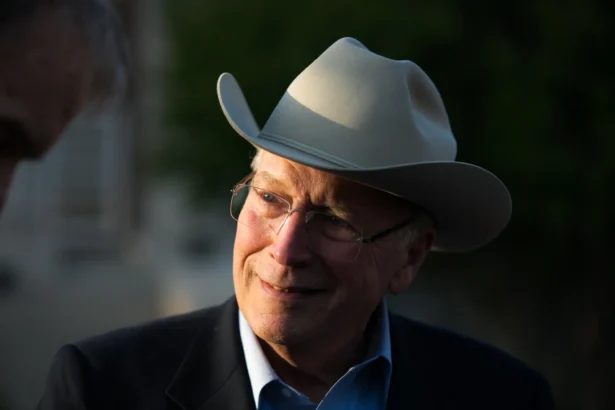
WASHINGTON — Richard B. Cheney, the former U.S. vice president whose iron-fisted influence shaped the early 21st century’s most divisive foreign policies, has died at the age of 84. His passing on Monday evening marks the end of a life defined by resilience against personal frailty and unyielding conviction in the face of national turmoil. According to a family statement, Cheney succumbed to complications from pneumonia, compounded by long-standing cardiac and vascular issues—a battle his heart had waged for decades, sustained by groundbreaking medical interventions and, at one critical juncture, the lifeblood of a stranger.
Cheney’s death closes a chapter on one of the most polarizing figures in modern American politics. Once dubbed the “most powerful vice president in history,” he wielded unprecedented sway during George W. Bush’s administration, steering decisions on the Iraq War, enhanced interrogation techniques, and the expansion of executive authority in the wake of the September 11 attacks. Yet, beneath the hawkish exterior lay a man whose own body had rebelled early and often, forcing him to confront mortality in ways that mirrored the high-stakes gambles of his career.
A Lifetime of Defiance Against Adversity
Born on January 30, 1941, in Lincoln, Nebraska, Dick Cheney grew up in Wyoming, where he developed a pragmatic, no-nonsense worldview shaped by ranchlands and raw ambition. His early years were unremarkable—community college, a brief stint in the oil fields, and a political awakening sparked by a summer internship in Washington. But health would cast a long shadow over his ascent.
Also Read: RIP Donna Jean: BADASS Tributes to Her Feminine Force That ROCKED the Dead
Cheney’s first heart attack struck at age 37, in 1978, while he was a young congressman-elect from Wyoming. It was the opening salvo in a series of five attacks that would test the limits of medical science and human endurance. Over the years, he endured quadruple bypass surgery in 1988, two coronary stent placements, and the implantation of a pacemaker and left ventricular assist device (LVAD) in 2012. By then, his heart was operating at a fraction of its capacity, a fragile engine powering a formidable mind.
The most dramatic chapter unfolded on March 24, 2012, when Cheney received a heart transplant from an anonymous donor in northern Virginia. At 71, he was among the oldest recipients at the time, a procedure that bought him 13 more years—time he spent writing memoirs, advising on national security, and, later, breaking ranks with his party to denounce Donald Trump’s assault on democratic norms. “In a way, I was reborn,” Cheney reflected in his 2011 memoir In My Time, a sentiment that took on literal weight just a year later. That donor’s gift—someone else’s blood, pulsing through his veins—extended a life that seemed destined for an earlier curtain call.
For the past 14 years, Cheney had lived on what many close to him called “borrowed time.” He managed his condition with a regimen of medications, rigorous monitoring, and the quiet determination that had propelled him from Wyoming’s backroads to the West Wing. Yet, insiders noted the toll: frequent hospitalizations, a voice grown softer in public appearances, and a deliberate withdrawal from the fray as his health faltered. His final days were spent at his beloved Wyoming ranch, surrounded by family, where he found solace in fly fishing—a passion the family eulogized as emblematic of his “courage, honor, love, kindness.”
Legacy: Power Broker in an Era of Shadows
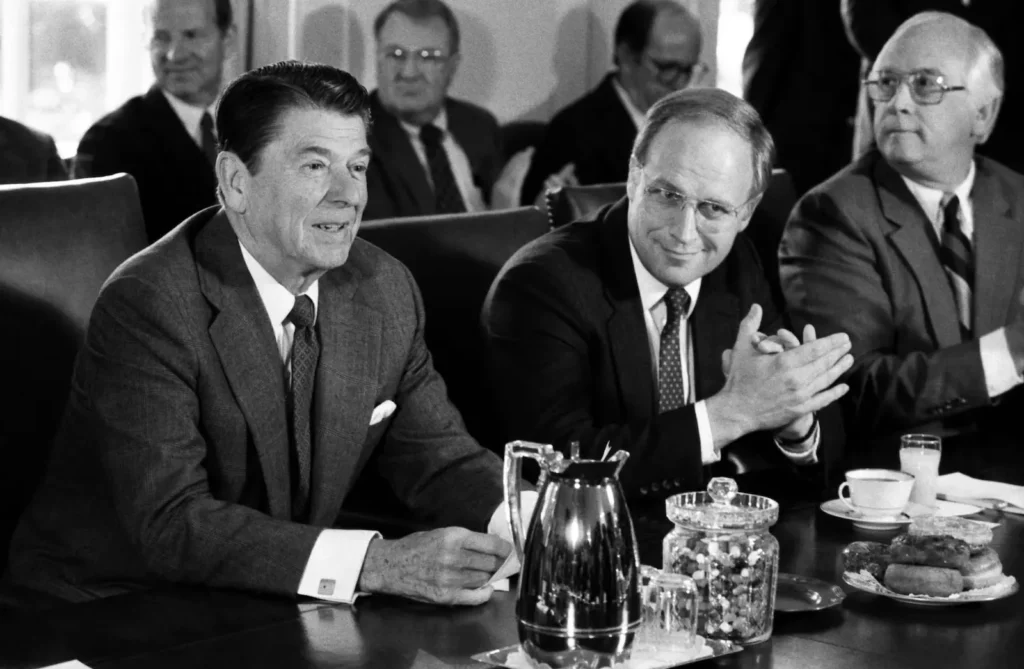
Cheney’s political odyssey began in earnest under President Gerald Ford, where as White House chief of staff at 34, he became the youngest ever in that role. He later served as a Wyoming congressman for a decade, then as defense secretary under George H.W. Bush during the Gulf War. But it was as vice president from 2001 to 2009 that Cheney etched his name into history—and controversy.
In the smoke of 9/11, Cheney emerged as the administration’s intellectual force, advocating for the invasion of Iraq based on intelligence about weapons of mass destruction that later proved flawed. He championed the Patriot Act, warrantless surveillance, and “enhanced interrogation” methods that critics labeled torture. Detractors portrayed him as a warmonger with ties to the defense industry—his tenure at Halliburton, where he earned millions, fueled endless scrutiny. Supporters, however, hailed him as a defender of American security in a perilous age, crediting his steady hand with preventing further attacks on U.S. soil.
Post-White House, Cheney’s influence lingered. He co-authored bestsellers critiquing the Obama era and, in a stunning 2022 twist, narrated an ad for his daughter Liz Cheney’s reelection bid, blasting Trump as a threat to the republic. Liz, who lost her seat for her January 6 stand, called her father “the moral compass of our family” in a heartfelt tribute Tuesday.
Tributes Pour In: From Gratitude to Grudging Respect
The news of Cheney’s death elicited a spectrum of reactions, underscoring his ability to inspire both fierce loyalty and sharp rebuke.
Former President George W. Bush, in a statement, described Cheney as “a great and good man” whose counsel was “invaluable” during their shared trials. “Dick’s wisdom and grit helped guide our nation through dark days,” Bush said. “He was a friend whose loss we feel deeply.”
President Joe Biden, who crossed paths with Cheney in the Senate, offered condolences laced with bipartisan grace: “Dick Cheney served his country with unwavering dedication, even when we disagreed profoundly. His personal battles with illness were a testament to the American spirit of perseverance.”
From the right, figures like Senate Minority Leader Mitch McConnell praised Cheney’s “unmatched expertise in defense and foreign affairs,” while Trump, in a terse Truth Social post, acknowledged the passing without apology for past barbs. On the left, progressive voices like Sen. Bernie Sanders reflected on the costs of Cheney’s policies: “His vision of unchecked power left scars on our democracy and the world, but we honor the man who fought so hard to live.”
Cheney’s family, in their statement, captured the man beyond the headlines: “We are grateful beyond measure for all Dick Cheney did for our country. And we are blessed beyond measure to have loved and been loved by this noble giant of a man.”
A Heart That Outlasted Its Wars
In the end, it was not the political battles that felled Dick Cheney, but the organ he had fortified through sheer will and modern medicine. His heart—scarred, transplanted, and tenacious—gave out after outlasting two impeachments, endless inquiries, and a body that had every reason to quit decades ago. As the nation pauses to assess his indelible mark, one truth endures: Richard Cheney borrowed time not just from science and sacrifice, but from the unyielding drive that defined him. In death, as in life, he leaves a legacy as complex as the man himself.
Funeral arrangements remain private, with a memorial service expected in Washington next week. Cheney is survived by his wife of 58 years, Lynne; their daughters, Elizabeth and Mary; and five grandchildren.
Elena Vargas covers U.S. politics and national security for Global Insight News. This article draws on public records, family statements, and historical accounts to honor Cheney’s life without endorsement of his policies.