
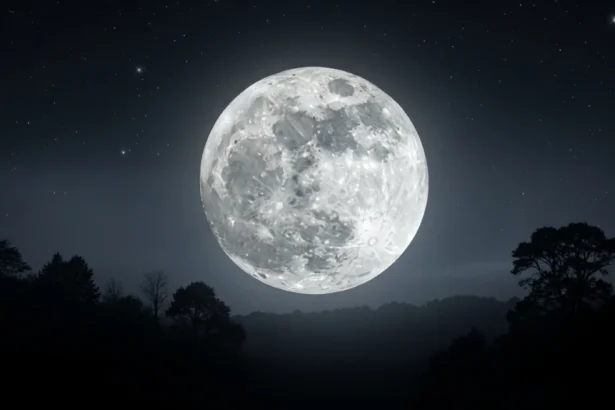
As the crisp autumn air settles in, the night sky is set to deliver one of its most captivating displays of the year. On November 5, 2025, the full moon November 2025—affectionately known as the Beaver Supermoon—will light up the heavens, marking the largest and brightest full moon since 2019. This celestial event isn’t just a routine lunar phase; it’s a supermoon, occurring when the moon is at its closest point to Earth during its full phase. For stargazers, astrologers, and nature enthusiasts alike, it’s a prime opportunity to connect with the cosmos. In this article, we’ll break down the essential facts, explore enduring myths, and share practical tips on what to watch for during this glowing spectacle.
The Essential Facts: What Makes the November 2025 Full Moon Special
The full moon November 2025 arrives at a pivotal moment in the lunar calendar, blending scientific precision with seasonal timing. Officially, the moon reaches peak illumination on Wednesday, November 5, at 8:19 a.m. Eastern Time (13:19 UTC), though it will appear full to the naked eye for several nights before and after. This particular full moon earns its “supermoon” status because it coincides with perigee—the moon’s closest approach to Earth—making it stand out from the crowd of 12 full moons we see annually.
At just 221,817 miles (about 356,980 kilometers) from our planet, this Beaver Moon is the closest supermoon of 2025, surpassing even the other two supermoons in October and December. To put that in perspective, the moon is typically around 238,855 miles away on average, so this one will appear roughly 14% larger in diameter and 30% brighter than a standard full moon. It’s the second in a trio of consecutive supermoons, amplifying the drama of late-year skies. For comparison, the April 2025 full moon was an apogee event (farthest point), appearing noticeably smaller at over 252,000 miles distant.
The name “Beaver Moon” hails from Native American and colonial American traditions, tied to the industrious beavers that feverishly build dams in preparation for winter’s freeze. This full moon also signals the time when hunters would stock up on provisions, earning it the alternate moniker “Hunter’s Moon” in some regions. Astronomically, it’s a reminder of the moon’s elliptical orbit, which takes about 27.3 days to complete, pulling it into perigee roughly every month but aligning with fullness only three times this year.
In an era of increasing light pollution, events like the full moon November 2025 remind us of the moon’s role as Earth’s faithful companion—a natural satellite that influences tides, inspires art, and even subtly affects wildlife behavior. Whether you’re a casual observer or a dedicated astronomer, this full moon promises a visual treat without needing fancy equipment.
Also Read: RIP Donna Jean: BADASS Tributes to Her Feminine Force That ROCKED the Dead!
Myths and Legends: The Cultural Magic of the November Full Moon
Full moons have woven themselves into the fabric of human storytelling for millennia, and the November 2025 full moon is no exception. While scientific facts ground us, myths add a layer of enchantment, turning a simple lunar phase into a symbol of transition and mystery.
In Indigenous North American lore, the Beaver Moon embodies preparation and resilience. As leaves fall and nights lengthen, it marks the shift toward winter’s hardships, urging communities to gather resources much like beavers fortify their lodges. European settlers adopted the name, blending it with their own “Frost Moon,” evoking the first hard frosts that blanket the ground. Across the Atlantic, Celtic traditions viewed November’s full moon as a gateway to the “thin veil” between worlds, a time for honoring ancestors during Samhain (now Halloween). In Hindu culture, it aligns with Kartik Purnima, a festival of lights and gratitude, where devotees fast and perform rituals for spiritual cleansing.
Of course, full moon lore isn’t without its darker threads. The term “lunacy” stems from ancient beliefs that the moon’s pull could induce madness or erratic behavior— a notion debunked by modern studies but persistent in pop culture through werewolf tales and sleep disruption claims. Some superstitions warn against major decisions under a full moon, fearing heightened emotions, while others celebrate it as a powerhouse for manifestation. In Chinese mythology, the moon goddess Chang’e dances eternally, her silhouette inspiring poetry and festivals like the Mid-Autumn Festival (though not directly November-tied).
For the full moon November 2025, astrologers highlight its placement in Taurus, a grounded earth sign that amplifies themes of stability, sensuality, and release. Vedic perspectives might frame it in Aries for fiery action, but the common thread is one of closure: shedding old habits as winter looms. These stories aren’t mere fancy; they reflect how early societies tracked seasons via the moon, using its cycles for agriculture, hunting, and rituals. Today, as we face our own “winters” of uncertainty, the Beaver Moon invites reflection on abundance and endurance.
What to Watch For: Viewing Tips and Sky Events Around the November 2025 Full Moon
With the full moon November 2025 just days away—peaking on November 5 but visible from November 4 onward—preparation is key to a memorable viewing. The moon’s low position in the sky this month enhances the iconic “moon illusion,” making it look enormous as it rises against the horizon. Here’s how to make the most of it, plus bonus sky happenings.
Prime Viewing Tips
- Timing and Location: Catch the moonrise just after sunset on November 4 (around 5-6 p.m. local time, depending on your spot) or early evening on November 5. Head to an elevated, east-facing vantage point like a hill, beach, or open field with minimal city glow. Urban dwellers can use apps like Stellarium or The Old Farmer’s Almanac for exact rise times.
- Gear and Prep: Binoculars or a basic telescope will reveal craters and maria (dark “seas”) in stunning detail, but the naked eye suffices for the spectacle. Dress warmly, pack a thermos of hot cider, and arrive early to beat crowds.
- Photography Hacks: Use a tripod for long exposures to capture the moon’s golden hue against silhouetted trees or buildings. Wide-angle lenses exaggerate the illusion—pair it with foreground elements for dramatic shots.
Astrological and Spiritual Angles
In Taurus, this full moon encourages grounding practices: journal about financial security, meditate on self-worth, or perform a release ritual by writing worries on paper and safely burning them. It’s a potent time for manifestation around home and comfort, especially with Jupiter retrograde urging introspection.
Other Sky Events to Spot
November 2025 is a stargazer’s buffet. The Taurid meteor shower peaks around November 5-12, potentially sending fireballs streaking past the moon—up to 5-10 per hour from a dark site. The Leonids ramp up later in the month, adding shooting stars for late-night vigils. Look for winter constellations like Orion rising in the east, his belt pointing toward the hunter’s moon. If you’re in the Southern Hemisphere, the moon’s path offers views of the Southern Cross.
Weather permitting, this full moon could coincide with clear, frosty nights ideal for aurora spotting in northern latitudes, thanks to ongoing solar activity. Apps like SkySafari can overlay these events for real-time guidance.
Gazing into the Future: Why the November 2025 Full Moon Matters
The full moon November 2025 isn’t just another glow in the dark—it’s a bridge between science and soul, facts and folklore. As the Beaver Supermoon illuminates our path through shortening days, it whispers of preparation, wonder, and renewal. Whether you’re debunking werewolf myths with friends, snapping horizon photos, or simply tilting your head skyward, this event reminds us of our place in the vast universe.
Mark your calendar for November 5, step outside, and let the moon work its quiet magic. Who knows? In its silvery light, you might just spot a beaver dam—or the start of your own winter wisdom. For more lunar updates, follow astronomy feeds or local observatories. Clear skies ahead!