

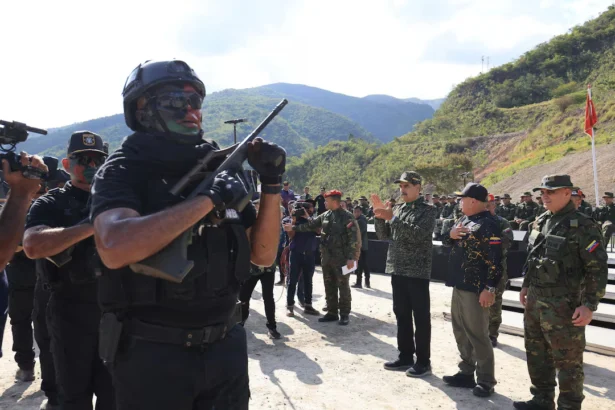
As the USS Gerald R. Ford, the world’s largest aircraft carrier, steams toward the southern Caribbean amid the US military buildup Caribbean, the United States has unleashed its most aggressive military posture in Latin America since the 1989 invasion of Panama. What began as targeted strikes on suspected drug boats has ballooned into a massive deployment of warships, fighter jets, and special operations forces. With President Donald Trump’s administration openly discussing strikes on Venezuelan soil under Trump Venezuela policy, the region braces for fallout. This buildup, framed as a counternarcotics push, raises alarms about regime change ambitions, economic ripple effects, and a potential proxy conflict involving Russia and China. For Latin America, the stakes couldn’t be higher: stability hangs by a thread amid the Venezuela crisis 2025.
- A Surge of Steel: Mapping the U.S. Military Buildup in the Caribbean
- Trump’s Venezuela Policy: From Sanctions to Strikes
- The Venezuela Crisis 2025: A Powder Keg of Poverty and Repression
- CIA Covert Ops: Shadows of Empire in Caracas
- Latin America’s Tightrope: Migration, Alliances, and Economic Tremors
- The Road Ahead: Deterrence or Disaster?
A Surge of Steel: Mapping the U.S. Military Buildup in the Caribbean
The escalation kicked off in late August 2025, when Trump signed a classified directive authorizing the Pentagon to use lethal force against Latin American drug cartels labeled as “narcoterrorists.” By mid-October, U.S. Southern Command (SOUTHCOM) had amassed an unprecedented arsenal in the Caribbean Sea, deploying over 10,000 troops across ships, Puerto Rico, and allied ports like Trinidad and Tobago. This US military buildup Caribbean dwarfs previous operations, signaling a shift toward direct confrontation in the Venezuela crisis 2025. Here’s a breakdown of the key assets:
| Asset Type | Details | Purpose (Stated) |
|---|---|---|
| Naval Forces | USS Gerald R. Ford carrier strike group (90+ aircraft); USS Gravely destroyer; 8 warships total; 1 nuclear-powered submarine | Counter-drug interdiction; potential precision strikes on coastal targets |
| Air Assets | 10 F-35 stealth fighters in Puerto Rico; B-52 Stratofortress bombers (4-hour patrols off Caracas); MH-6 “Little Bird” special ops helicopters; P-8 Poseidon surveillance planes | Bomber “attack demonstrations”; intelligence gathering; rapid response to Venezuelan flyovers |
| Ground & Support | 160th Special Operations Aviation Regiment (Night Stalkers); 5,000 troops in Puerto Rico; reopened Roosevelt Roads base | Covert insertions; joint exercises with Trinidad; troop surge for sustained ops |
Since September 2, U.S. forces have sunk at least 10 vessels in the Caribbean and eastern Pacific, killing over 40 people in what Washington calls “defensive actions” against boats linked to the Tren de Aragua gang and Cartel de los Soles. The latest strike on October 30 targeted a Pacific boat, claiming four lives. Critics, including UN officials, decry these as disproportionate, potentially unlawful attacks on civilians.
Puerto Rico has become a nerve center, hosting F-35s and a refueling hub on St. Croix. In Trinidad, the USS Gravely docked for joint drills just six miles from Venezuela‘s coast, prompting Caracas to label it a “provocation.” Analysts note this echoes 19th-century “gunboat diplomacy” to coerce weaker nations.
Also Read: Why Trump Wants to Invest in Quantum Computing Companies Right Now
Trump’s Venezuela Policy: From Sanctions to Strikes
Trump’s approach blends his first-term “maximum pressure” with bolder tactics in the Venezuela crisis 2025. In July 2025, he designated the Cartel de los Soles—allegedly led by Nicolás Maduro—as a foreign terrorist organization, tying it to fentanyl flows despite DEA reports showing minimal Venezuelan involvement (98% enters via Mexico). A $50 million bounty on Maduro for narcotrafficking underscores the personal vendetta.
On October 15, Trump confirmed authorizing CIA covert ops Venezuela, including lethal actions, to “end the crisis.” This “finding” allows the agency to target Maduro’s inner circle or infrastructure, potentially alongside military raids. Secretary of State Marco Rubio, a vocal hawk, has shaped this shift, sidelining oil-focused diplomacy for a “criminality” narrative.
Exiled Venezuelan officers warn Maduro’s 125,000-strong military “wouldn’t last hours” against a U.S. assault, citing outdated gear and low morale. Yet, with Russian Su-30 jets and S-300 systems, Caracas vows asymmetric resistance. Trump weighs Tomahawk missiles on ports and airfields used for trafficking, per WSJ sources.
The Venezuela Crisis 2025: A Powder Keg of Poverty and Repression
Venezuela‘s woes predate this showdown in the Venezuela crisis 2025. Over 20 million of 28.8 million citizens live in multidimensional poverty, with 14.2 million needing urgent aid for food, health, and shelter. Hyperinflation lingers, though oil output hit 874,000 barrels daily in 2024, fueling 8.5% GDP growth. Sanctions and Maduro’s post-2024 election crackdown—detaining 827 political prisoners—exacerbate the humanitarian toll.
Maduro’s regime, clinging to power after disputed July 2024 polls, faces 90% disapproval. Opposition icon María Corina Machado, 2025 Nobel Peace laureate, calls for a unified transition, dismissing civil war fears. Eight million Venezuelans have fled since 2015, straining neighbors like Colombia.
Recent floods in Valencia highlight infrastructure collapse, with 3 million kids out of school and 190,000 university dropouts. Maduro’s “economic emergency” declaration masks deepening woes.
Also Read: Twitch Shockwave: Emiru Accuses Mizkif of Sexual Assault and Blackmail After TwitchCon
CIA Covert Ops: Shadows of Empire in Caracas
The CIA covert ops Venezuela greenlight evokes Latin America’s haunted history of U.S. meddling—from Chile’s 1973 coup to Nicaragua’s Contras. Trump’s October 15 nod enables “lethal ground operations,” per leaks, building on a 2020 cyberattack that crippled Maduro’s intel network. Past ops, like failed 2018 assassination plots, underscore risks of blowback.
Venezuela decries this as “coups d’état,” vowing UN complaints. With SVR intel reportedly souring Moscow’s view, even Putin evacuated diplomats October 25, signaling Maduro’s isolation.
Latin America’s Tightrope: Migration, Alliances, and Economic Tremors
This U.S. flex reverberates continent-wide amid the US military buildup Caribbean. Colombia fears spillover violence; Brazil’s Landless Workers’ Movement rallies solidarity brigades for Venezuela, evoking Spanish Civil War aid. China, holding Venezuelan oil loans, conducted 97 military exchanges with 18 regional states by 2025; Russia arms Maduro but hedges bets.
A full U.S. intervention could spike migration—already 8 million displaced—overwhelm borders, and crash oil markets (Venezuela holds reserves rivaling Saudi Arabia). Analysts like John Mearsheimer warn of “dark irony”: U.S. overreach invites Russian missiles, echoing the 1962 Cuban Missile Crisis.
Regional voices, from Cuba’s embassy in Jamaica to Brazilian activists, urge dialogue over aggression. The EU echoes calls for democratic transitions sans invasion.
The Road Ahead: Deterrence or Disaster?
Trump’s gamble under Trump Venezuela policy aims to fracture Maduro’s elite by starving cartel revenues, but experts doubt it’ll topple him without boots on ground—politically toxic post-Afghanistan. Maduro mobilizes coastal defenses and propaganda, framing U.S. moves as oil grabs.
For Latin America, the Venezuela crisis 2025 tests unity. A prolonged standoff risks proxy escalations, economic shocks, and refugee waves. As B-52s patrol Caracas skies, the question looms: Will this deter trafficking, or ignite a firestorm? Regional leaders must push for talks—preconditions be damned—to avert catastrophe. Stability demands more than missiles; it requires multilateral resolve.